Spanish Christmas Lottery: A 200 Years Tradition
Submitted by Anonymous (not verified) on Tue, 12/25/2012 - 01:00
Spanish Christmas Lottery: A 200 Years Tradition The Spanish Christmas Lottery is the most widely played chance game and every Spaniard dreams of being rich and lucky at the end of the month of December. It is another trademark of Christmas traditions Spanish Christmas Lottery: A 200 Years Tradition

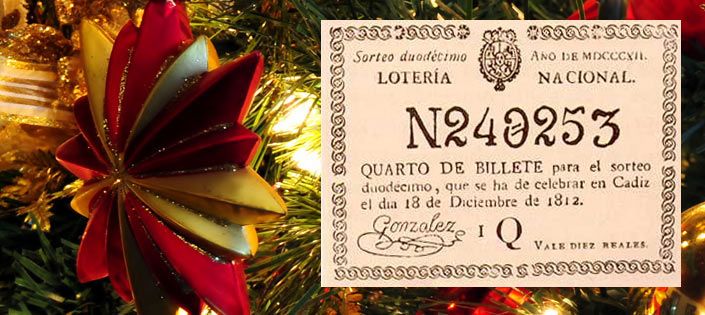
The Spanish Christmas Lottery (la Lotería de Navidad) is the most widely played chance game and every Spaniard dreams of being rich at the end of December. It is another trademark of Christmas traditions that one must live the excitement whether “El Gordo” (the biggest prize) will touch him this time.

The first contemporary lottery was created in 1812 in Cadiz to support the state revenue for public tax authority and in 1814 the first official drawing was held in Madrid which later has become the center and the day of 22nd of December has been the official date for Christmas lottery, that is also acknowledged as the beginning of the holidays.  

The lottery tickets are official papers and counterfeiting is strongly prohibited. Each ticket is divided into series (195 series per number) and each series is divided into ten shares which is called decimos is at price of 20€. Since 2011 the number of series has been 100.000 started from 00000 to 99999. The biggest prize (the amount is 4.000.000€) is called el Gordo which literally means the fat one. It is not the biggest amount given considering the other lotteries though it is the most desired one among Spaniards even you should notice the phrase tocarle el gordo a alguien (to win el gordo) referring to get something you wish for with the help of luck. The winning numbers are chosen by randomly with two drums including boxwood balls on which the numbers are written with laser so as to keep the same weight. The first one contains 99.999 balls and the next drum is the prize drum that has all the 1807 balls determining the winners of the prizes. Since the beginning of the lottery, the students of San Ildefonso have the duty to sing out the winning numbers.

If you are staying in Spain during Christmas time, you should give a chance for el Gordo to touch you to start a prosperous year.  

Facts about the Spanish Christmas Lottery

It has been held every year without any cancellation not even during Civil War

The tickets are started to be sold in July

In 2002 the prizes are turned into Euro and the drawing took shorter 9 minutes less because it was not as long as the previous years when the prize was in pesetas.

The ticket ending with the number 1 is the unluckiest which has come out 8 times so far, the luckiest one is the number 5 coming 32 times.
Traditions Spain The Spanish Christmas Lottery is the most widely played chance game and every Spaniard dreams of being rich and lucky at the end of the month of December. Christmas Lottery,Christmas celebration in Spain,Spanish culture Off <!-- Revive Adserver Etiqueta JS asincrónica - Generated with Revive Adserver v5.0.2 --><ins data-revive-zoneid="7" data-revive-id="ec923599c3fad9b044f22a6a73433428"></ins><script async src="//ads.iegrupo.com/www/delivery/asyncjs.php"></script> Dilek

Spanish cooking in wintertime | donQuijote

Submitted by Anonymous (not verified) on Thu, 11/22/2012 - 01:00
Spanish Cooking in Wintertime Enjoy traditional Spanish dishes at home and try some of our typical Spanish récipes, which can help you confront the rainy autumn and the cold winter. Spanish Cooking in Wintertime

When the rain and the first cold spells arrive, we feel like trying "comfort" recipes that can recharge our energy and fill our stomachs… and our spirits. Below, you'll find three of our favorite Spanish recipes, which can help you confront the rainy autumn and the cold winter. Keep on joining us on our blog - soon you will discover more traditional Spanish dishes of other Spanish regions.

Besugo al horno (Baked Sea Bream)

Ingredients

1 kilo sea bream, 4 potatoes, 1 green onion, 1 green pepper, 6 cloves of garlic, Spanish Olive oil, salt, chopped parsley, ½ guindilla pepper

Preparation
Cut 4 of the garlic cloves in slices, the green onion and the pepper in thin strips and the potatoes in thick slices. Cook it all in a pan on low heat. When it's almost done, transfer it to a cooking tray, covering the bottom surface. Put it in the preheated oven and cook for 15 minutes. Clean the bream, remove the head and the tail and save them. Separate the fillet meat, removing the spine. Salt as desired and place the bream fillet, with the skin side up, over the mattress of potatoes on the cooking tray. Also place the head and the tail here. Moisten with a little more oil and put the tray in the hot oven for 10 minutes. Serve in a serving dish with the skin side down. Chop the other two cloves of garlic into small cubes. Sauté them in a pan with oil and the guindilla pepper without the seeds (they're too spicy). Add some of the juice from the bream left in the cooking tray. Add the chopped parsley, mix well and pour the sauce of the fish.
Serve with the baked potatoes to one side and the fish with the skin side down.

Cocido madrileño (Madrilenian Stew)

Ingredients
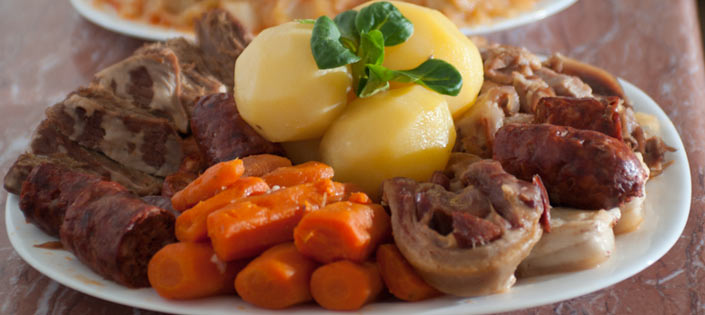
250 g of garbanzo beans, 300 g of beef sirloin tip, ¼ chicken, 100 g of tocino entreverado (a type of bacon), 100 g of blood sausage, 100 g of chorizo sausage, 50 g of Serrano ham, 4 small beef marrow bones, 1 kg. of cabbage, 4 medium sized potatoes, 100 g of noodles for the soup, 2 carrots,  1 onion, 1 turnip, 1 clove of garlic, olive oil, salt

Preparation
Soak the garbanzo beans the night before in warm water and with a little bit of salt. In the morning, drain them. Place the meats, the tocino, the cleaned bones and the Serrano ham all in the pressure cooker and cover with water. Place it on the stove top and close it. When it starts to boil, the foam will rise to the surface. Remove the foam with a skimmer and add the garbanzos. When the water boils again, add the carrot, the onion and the turnip. Cook under pressure for 30 minutes to soften the garbanzos.
Open the cooker and add the potatoes (peeled and cut into pieces that aren't too small). Try it and salt to taste. Remove the vegetables and the garbanzos and put them to the side, leaving the broth to prepare the noodle soup. At the same time, in another cooking pot, cook the chopped cabbage for half an hour. Drain, and lightly fry with the garlic. Cook the chorizo sausage and the blood sausage in a separate pan so the color won't mix with the broth.

Presentation: Cocido Madrileño is eaten in three steps. First, the noodle soup is served (noodles must be cooked in the broth for 5 minutes). Then, the garbanzos are served in a serving dish with the vegetables: the lightly fried cabbage, the carrot, and the sliced turnip (about 2 centimeters). The onion is added to the broth to give it flavor, but then it's removed. In the third step, serve the meats cut into pieces, the chorizo and the blood sausage, the tocino and the bones pieces. The marrow spread over toast is delicious.

Patatas a la riojana (Rioja style potatoes)

Ingredients

6 potatoes, 3 chorizo sausages, 1 onion, 1 green pepper, 2 bell peppers, 1 head of garlic, Water, olive oil, salt, 2 bay leaves, 1 guindilla pepper (optional)


Preparation
Place the chopped onion and green pepper in a pressure cooker along with a little oil. Add the entire head of garlic, the bay leaves and the guindilla pepper (this is optional, depending on if you want it spicy or not). Add the sliced chorizo and the potatoes which must be broken into pieces using a knife and your hands (this makes the broth thicker). Cover with water and add salt. Cook for 5 minutes beginning from the time the cooker is pressurized. Soak the bell peppers in warm water after removing the seeds. When they've rehydrated, scrape off, chop up and save the pulp. Open the pressure cooker, take out the head of garlic and the guindilla pepper (if you added it). Add the bell peppers, stir and cook for two more minutes (so the flavors mix). Salt to taste.

Culture Traditions Enjoy traditional Spanish dishes at home and try some of our typical Spanish récipes, which can help you confront the rainy autumn and the cold winter. olive oil,spanish recipes,spanish dishes,winter recipes,spanish cooking Off <!-- Revive Adserver Etiqueta JS asincrónica - Generated with Revive Adserver v5.0.2 --><ins data-revive-zoneid="7" data-revive-id="ec923599c3fad9b044f22a6a73433428"></ins><script async src="//ads.iegrupo.com/www/delivery/asyncjs.php"></script> Lauris
Subscribe to Traditions

Manage cookie consent

Cookies on this website are used to personalize content and ads, provide social media features and analyze traffic. In addition, we share information about your use of the website with our social media, advertising and web analytics partners, who may combine it with other information you have provided to them or that they have collected from your use of their services. You can learn more in our Cookies policy

Always active

Necessary cookies help make a website usable by enabling basic functions such as page navigation and access to secure areas of the website. The website cannot function properly without these cookies.

Statistical cookies help website owners understand how visitors interact with websites by gathering and providing information in an anonymous form.

Preference cookies allow the website to remember information that changes the way the site behaves or looks, such as your preferred language or the region you are in.

Marketing cookies are used to track visitors on web pages. This is used to show ads that are more relevant and attractive to the individual user, and therefore more valuable to publishers and third-party advertisers.