enforex_pages_related_block_6d8f64f7-7035-4100-96f2-02a834f19e93
Other Summer Camps
Skill level
From 10 March to 12 June 2016 at the ABC Museum in Madrid, we can see an exhibition about Spanish cartoonists who were part of the team of well-known publishers such as Marvel and DC.
Superheroes seem to us to be something alien to Spanish creation and, so much so, that it seems that the only way for a Spaniard to be linked to this world is to do the Americas. But the truth is that the creation of Spanish superheroes has been fruitful for almost a century. Here are some of the most outstanding Spanish superheroes.
Súper López
The most famous Spanish superhero is, without a doubt, Súper López, a humorous adaptation of Superman by Juan López Fernández (JAN) in which an office worker who loves origami hides in his skin powers that surpass any human capacity. The author always tries to use different points of view to tackle current issues that Spanish society suffers from every day. Despite his similarity to the famous Kryptonian, Super López has acquired his own personality and international fame.
Capitán España
Project IDE sought to create a European supergroup to confront the villains threatening this part of the world, where the more famous superheroes were not active. One of the original members was Captain Spain, a former soldier named Carlos Fraile who was implanted with biomechanical advantages and nanobots that increased his abilities, including the ability to fly. His greatest achievement was defeating Thor when he went mad.
El Águila
Like Captain Spain, the Eagle belongs to the Marvel universe. His image is a little more cliché: red hood and red tights, black shirt and boots, wide-brimmed hat, an eagle on his chest... and great skill with a sword. Moreover, being a mutant, he has the ability to throw electric charges. Although he looks like he comes from the 17th century, he was born in Madrid and his real name is Alejandro Montoya. Could he be a descendant of the famous Íñigo Montoya from "The Princess Bride"?
El Capitán Trueno
With no powers or technology at his disposal, Captain Thunder has used his own talent with the sword and his passion for adventure to become a classic Spanish superhero. His stories began to be distributed in 1956, with a success that was still unprecedented in the national sector.
He was the leader of a trio of brave warriors formed by Trueno, Goliath and Crispín. The genre of his adventures is medieval action and his different adventures against all kinds of villains have been renewed until his last comic was published in 2010.
El Coyote
His story is reminiscent of that of "El Zorro": Don César, a rich Mexican heir with a reputation for being a lecher and a lecher is, in reality, a vigilante who fights for the rights of his people in the California that has been annexed to the United States. Hidden behind a mask, under a charro hat and displaying his skill with a pistol, he is an incarnation of justice created by the author José Mallorquí.
El Coyote was born as a character in pulp novels, but quickly became a comic book character and one of the first "fan phenomena" in the history of Spanish culture. Today, volumes of the character are the object of collection and reprinting.
Iberia Inc.
Probably the most unknown superhero project of all, despite its great potential. Behind it were the artists Rafael Marín and Carlos Pacheco. It began in 1992, but did not obtain publication rights until the end of the decade.
It is only a mini-series with 6 issues in which 8 superheroes work in the service of the Spanish government. The group was made up of Aquaviva, Dolmen, Drac de Ferro, Lobisome, Melkart, Traka, Trasnu and Trueno. The quality of the comic encouraged the creation of other parallel miniseries.
Some are more serious, others more parodic; but what is clear is that there is no lack of superheroes in Spain.
Halloween is approaching and a small controversy is flaring up: have we Spanish-speaking countries betrayed our roots by turning something as profound as All Souls' Day into something superficial?
Let's take it one step at a time: All Souls' Day is celebrated on the 1st and 2nd of November. In many places the 1st is a public holiday so people go out on the eve, and what better way to have fun the night before a holiday than a costume party? Besides, that doesn't mean we're being frivolous: many people who celebrate Halloween also remember their loved ones on the following days.
Controversy aside, it is curious to see how some countries have adapted Halloween to their culture. Let's give you some examples.
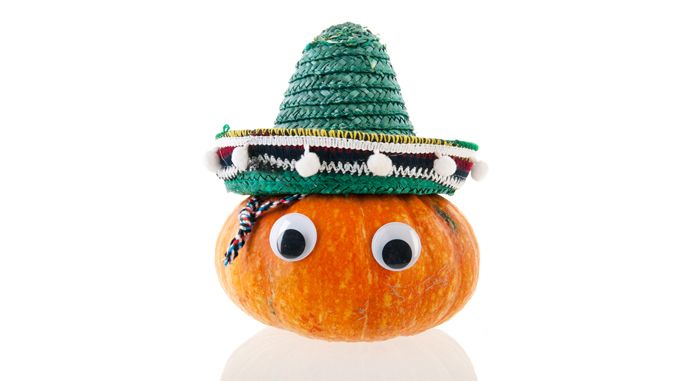
In México, of course, the big celebration is the Day of the Dead, but Halloween is also celebrated. It is curious to see how children have adapted trick-or-treating and go from house to house asking not for sweets, but for donations. On 31 October, costume parties are also held, but with little connection to the typical images of the Day of the Dead. The latter, as tradition dictates, is celebrated when it is due.
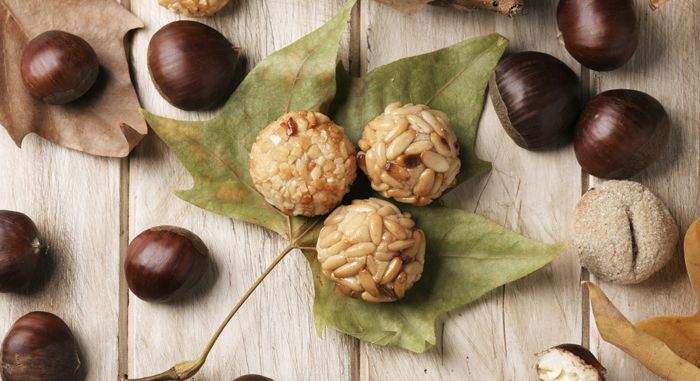
In Spain it is the case that, in the north of the country and especially in Galicia, a Celtic festival very similar to Halloween, called Magosto, was already celebrated between 1 and 11 November. However, in Spain they have adapted Halloween to the Spanish in an unexpected way: some families solve the "trick or treat" by giving children Christmas sweets such as nougat or marzipan. Many say this is one of the reasons why by mid-October you can already see all kinds of Christmas specialities in supermarkets.
In Argentina Halloween is celebrated as if it were carnival: parties, dances... a simple party to have a good time. For a while there was also controversy related to the adoption of a foreign custom and it was proposed that instead of monsters such as the werewolf or Dracula, American-style beings such as the Anchimalén goblin, the vampire Ehéie or the Mapuche monster Pihuchén would be the protagonists. The proposal - it's a pity - never came to fruition. What does take place every year in Buenos Aires is the Halloween Run, a night-time marathon in which people dress up in costume.
We were very surprised, we admit, to learn that Halloween was already being celebrated in Colombia in the 1960s, although it was a festival celebrated by urban high society. In the 1970s it spread to the rest of the population. By the way, in Cartagena de Indias there is an indigenous tradition reminiscent of trick-or-treating called Tintililillo: children go around the neighbourhoods singing a little song and asking for a few pesos.
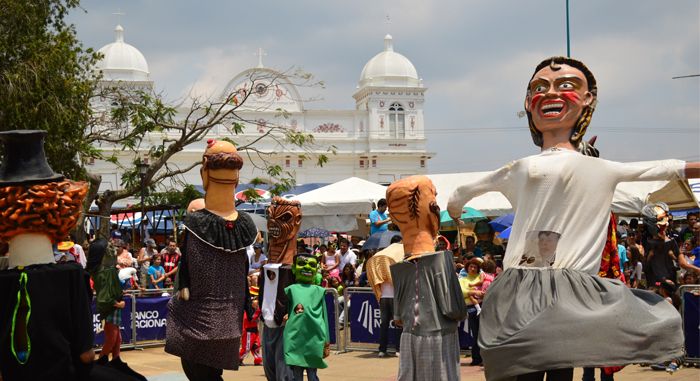
In Costa Rica the celebration of Halloween has served, ironically, to revitalise a somewhat forgotten custom, that of the masquerade. It is a festivity that unites the Spanish tradition of the giants and big-heads with indigenous traditions. Such has been the strength with which the festival has returned that in 1997 it was declared by decree that 31 October should be the national day of the traditional Costa Rican masquerade.
The clash between Halloween and tradition is most evident in Peru. Since 1944, 31 October was established as the day of one of the country's best-known traditional manifestations, the "canción criolla"; however, in recent years many Peruvians have dedicated the day to Halloween festivities. There have also emerged supporters of a third way, "Criolloween", which advocates uniting the aesthetics of one and the content of the other.
Halloween has taken hold, but the traditions refuse to go away, giving rise to parties, celebrations and very curious manifestations. Something very, very interesting.
Many of us are familiar with lunfardo words from the lyrics of the tangos so masterfully sung by Carlos Gardel, among other great interpreters of the genre. Let's get to know a little better the origins and characteristics of this slang that originated in Argentina, which nowadays has been incorporated to a great extent in the speech of Argentina, Uruguay and Paraguay. It is considered to have more than 6,000 words.
Origins and characteristics of lunfardo
Lunfardo is a slang or repertoire of words originating in the neighbourhoods of Buenos Aires (Argentina), which also developed in other sister cities such as Rosario (Argentina) or Montevideo (Uruguay). Originally, around the middle of the 19th century, it was a slang spoken by delinquents, which incorporated many words from Spanish, Italian and other immigrants. With these special words and expressions, which did not appear in dictionaries, the prisoners managed to avoid being understood by the guards during their stay in prison and could plan their escapes and crimes, etc. These were times of immigration and incessant port activity in the three cities mentioned above. Over time, lunfardo spread through all social classes, so that many of these words permeated the colloquial forms of Spanish speech of Argentines and many other Hispanic countries.
It should be made clear that, despite certain claims and its widespread use, lunfardo is not a language but a very specific lexicon, since it does not contain all the parts of speech. It has three important elements: the noun, the adjective and the verb, but lacks articles, pronouns, prepositions and conjunctions. It therefore lacks syntax, always using the original Spanish syntax.
The sounds of lunfardo are mainly inherited from the languages of Italy. In Argentina, Italian immigration was very important and has influenced its vocabulary. Other words come from French, Portuguese, English and even Quechua, among others. For example, a slang word such as Bacan (a very wealthy person) comes from Genovese. In the same case we find the expression Engrupir, which means to deceive. Tamango (shoe) comes from Portuguese and Cana (prison) from French, while Bichicome (vagabond) comes from English.
Lunfardo and tango
It is impossible to talk about lunfardo without also talking about tango, which has been its best ambassador all over the world. Lunfardo is the repertoire of words used in most tangos. A pioneer of tango, the musician and playwright Pascual Contursi, was the great introducer of lunfardo in this type of music. From then on, lunfardo poets and popular lyricists like Celedonio Esteban Flores further developed this way in collaboration with the singer Carlos Gardel, who recorded more than 20 songs with lyrics by this author. A good example would be the old tango "Mano a mano" (1923) with lyrics by the aforementioned Celedonio Estaban Flores and music by Gardel/Razzano.
But, is it possible to talk about a tango that has all the essence of lunfardo? It is difficult to choose among so many geniuses; but let's say that there is one that was chosen by Federico García Lorca himself. We are talking about "El Ciruja" (1926), with lyrics by Alfredo Marino and music by Ernesto de la Cruz. It is said that a porteño asked Lorca what he thought of the tango, to which the poet responded by sitting down at a nearby piano and began to play and sing the aforementioned song.
Many would have liked to have been present at that conversation. But we would go further even if we were more modest: we would have liked to compose a tango about such a story!
The dramatic literature of Spanish theatre has a long history, with authors who have marked an era and have influenced Spanish society over the centuries. Moreover, it has provided hundreds of very interesting characters, who belong to the imagination of Spaniards and of many foreign readers and spectators, who have helped generations and generations of people to enjoy and better understand life. Spanish theatre has made a definitive contribution to world literature and is the subject of study in schools and universities all over the world.
Medieval theatre
The theatrical production of the Golden Age was so great and so outstanding that we often forget that there was also theatre before that time. During the Middle Ages, there was religious drama (some plays are still performed today); court theatre, whose plays were performed by the king himself and his court as a pastime; or university theatre, written by students as an exercise in understanding classical plays. Another problem with this type of theatre is that there is no record of authors. Some would say that we would have to wait for the Celestina to know an outstanding author; but we must bear in mind that the name of Fernando de Rojas was not known until 1632.
The Golden Age
The Spanish Golden Age, the period of maximum apogee of Spanish Art and Literature, around the 16th and 17th century, which saw an impressive theatrical production, is especially well known and studied all over the world.
The best-known author of the Spanish theatre developed in the Golden Age is Lope de Vega, surely the most dazzling genius of those times. So much so that he was known in his time as "the phoenix of wits". He wrote thousands of works, novels and poems, including the plays Fuenteovejuna, La dama boba and El Perro del hortelano.
Calderón de la Barca is another of the great examples of that century of cultural flowering. His most outstanding and internationally best-known work is La vida es sueño (Life is a Dream).
One of the most outstanding names in classical Spanish theatre is Tirso de Molina. El burlador de Sevilla - the clear predecessor of the romantic "Don Juan Tenorio" - is his greatest work. The famous Miguel de Cervantes also wrote brilliant plays, such as El cerco de Numancia. Curiously, Cervantes' facet as a playwright is unknown to many.
The Enlightenment
The Golden Age was followed by a certain decline in dramatic art. The great playwrights had passed away and, although their continuators strove to keep the style alive, they did not achieve the greatness of their predecessors. The great renewal was influenced by the French Enlightenment movement. Reason, harmony and sobriety prevailed. The greatest exponent of Enlightenment theatre was Leandro Fernández de Moratín and his play El sí de las niñas. Less well known is the prolific work of the author Ramón de la Cruz, perhaps because of his dedication to more "popular" themes.
Romanticism
Another boom period of Spanish theatre is to be found in the age of Romanticism. A play from this period that has been performed millions of times is Don Juan Tenorio, by José Zorrilla. Another good emblematic example is Don Álvaro o la fuerza del sino, by Ángel de Saavedra. The works of this period are characterised by their high dramatic tone, their passionate themes and even the incorporation of supernatural elements. These works are still very popular today.
20th century
During the 20th century, the theatre of Jacinto Benavente stood out with plays such as Los intereses creados. The versatile writer Federico García Lorca offered some of the great works of this century, such as Yerma, Bodas de sangre or La casa de Bernarda Alba. For his part, Ramón María del Valle Inclán is another of the best exponents with titles such as Luces de bohemia and Divinas palabras. The 20th century also saw a vindication of humour through the theatre of the absurd, as demonstrated by the success of authors such as Miguel Mihura, author of Tres sombreros de copa or Maribel y la extraña familia; or Enrique Jardiel Poncela, author of Usted tiene ojos de mujer fatal or Las cinco advertencias de Satanás.
And with these we have practically reached what the textbooks give about Spanish theatre. What does the future hold for us? Theatre continues to be produced in Spain and of very good quality; but it is still too early to analyse. So the best thing to do is to experience it for yourselves.
If you google "the city of Oaxaca" you will immediately see links to travel blogs with titles like, "10 things to do in Oaxaca, the most fun city in Mexico," "Oaxaca, my favorite city in Mexico" and so on. So it may be clear, Oaxaca is a must-see destination in Mexico!
Oaxaca (pronounced o-wa-ga-ka) de Juárez is the capital of the Mexican state of Oaxaca and is a UNESCO World Heritage Site. The city is characterized by small alleys, plazas with cozy terraces, brightly colored houses and colonial buildings. But also the landscape surrounding the city is fantastic. Oaxaca offers you a perfect combination of city and nature.
What you should definitely do while in Oaxaca is visit one of the many markets. At the Mercado Juárez you will mostly meet locals doing their daily shopping. A fun way to check out what's in their shopping basket. You should visit the Mercado Sánchez Pascuas with an empty stomach, because that is a large indoor food market where you can order the most delicious Mexican dishes.
A typical Oaxacan dish is tlayuda a large crispy tortilla with a base of beans and a topping of guacamole, tomato, cheese and lettuce. By the way, this is a dish that can be seen as a full meal, because after this tlayuda you are guaranteed to be full. So if you want to be able to taste more things, share it with your travel companions!
In the middle of the city stands the Catedral which is also described as the most imposing structure in Oaxaca. The construction of the church took hundreds of years and the result is impressive. The richly decorated interior of the church is magnificent and well worth a visit.
If you want to go out at night, go to Café Central. A club where, in addition to DJs, many bands perform live. Every night of the week there is something going on, from dance parties to movie nights or a jazz concert by a Big Band.
From Oaxaca you can also plan fun excursions. The temple ruins of Monte Alban are really worth seeing. But don't skip the ruins of Mitla and a hike along the Pueblos Mancomunados (eight authentic Zapotean mountain villages) if you have the chance. On the coast - Yucatán - you can also have a great time and discover the flora and fauna of the sea while snorkeling or diving.
Although Oaxaca is called the cultural heart of Mexico, mass tourism is not (yet) very present. This allows you to enjoy the local culture, way of life and experience Mexico in a unique way.
And to make your trip to Oaxaca even more enjoyable, you can also take a Spanish course at our don Quijote school in Oaxaca where you can start a course every Monday of the year regardless of your current level!
After many years of representing our partner school from our office in the Netherlands, I started travelling through Colombia last January. The country which, thanks to its past and the popularity surrounding the series Narcos, is not often talked about in a positive way, but which has also seen a huge growth in tourism in recent years.
The city of Cali, the self-proclaimed capital of Salsa was the starting point to get used to the higher temperatures and the time difference. After a few days, we travelled on to Salento. This is a small tourist village, which is the base for visiting the Cocora Valley. A jeep from Salento takes 30 minutes to reach the valley, from where several hikes are possible through the cloud forests. As it rains daily, it is wise to start these hikes early. Besides this popular valley, we also visited a nature reserve where you go through all stages of the jungle in a few hours with a guide.
After Medellín, it was time for the popular Cartagena de Indias. A domestic flight gets you here in an hour and you can feel the Caribbean atmosphere as soon as you step off the plane. The air, the people and, of course, the high temperatures. Cartagena has two popular neighbourhoods, the old town and the Getsemani district. Both districts are within walking distance of each other. The Getsemani district, where our partner school is also located, is a maze of small streets and recognisable by the flowers you see hanging at balcony height everywhere. Many backpackers can be found there, making it seem very touristy, but the locals always remain friendly and interested. From Cartagena, we took a sailing yacht via the San Blas Islands to Panama City. It is a heady trip by sea, but once at the islands, everything is spectacularly beautiful!
We too received a lot of reactions in advance to our travel plans to Colombia. Of course, it makes a big difference that we speak Spanish, but we and many other travel companions experienced Colombia as an authentic country that feels and is very safe and where the local, helpful people proudly want to show you the country.
Marianne - Team dQ Nederland
In the middle of the lively tourist center of La Paz, the capital of Bolivia, is perhaps the craziest and most interesting market in South America: the "Mercado de Hechicería," or Witch's Market. This famous market is located between Sagamaga and Santa Cruz in Calle Jimenez. Dozens of vendors line the streets selling their fascinating and unusual products.
The market sells various products that Bolivian vendors and locals consider magical. Herbs, stones, figurines and... yes, also fetuses of llamas and dried frogs, turtles and snakes. These crazy products are all sold at the Witch Market and each has a magical side effect such as bringing good luck or curing disease. The products are mostly used by traditional Bolivian healers to influence good and evil spirits. In addition, the market is very popular to visit while on vacation in Bolivia.
The goodies are often packaged very nicely by the vendors, in cozy and colorful bags. These bags of products are still offered daily to Pachamama, the Mother of the Earth. This is an old-fashioned ritual that is still performed every day by the inhabitants of Bolivia. Indeed, according to tradition, it brings good luck if you bury a llama fetus under the cornerstone of your newly built house.
Besides dead llamas and dried frogs, some normal goodies are sold such as amulets with different images that stand for different things. For example, the sun stands for energy, the cougar for strength, the snake for cunning and wisdom, the condor for travel and change and the llama for health. You may also encounter a real traditional Yatari during your visit to the Witch Market. This is a medicine man who wears a large tall black hat. Yataris can predict the future but unfortunately do this mainly for the locals.
The Witches Market in La Paz is one of the most colorful and interesting markets in South America and well worth a visit during your trip through Bolivia. Not only are there weird souvenirs for sale, but the market also showcases much of Bolivia's faith and culture. And it's something different to take home a llama fetus as a souvenir instead of a magnet, right?
They are eaten for breakfast, as a daily snack and sometimes even after a party. We are talking about the crunchy fried flour stalks dipped in melted chocolate, or Spanish churros.
This Spanish delicacy is composed only of flour, oil, sugar, and salt. Eating churros, with or without chocolate, is an authentic Spanish tradition and is considered a very cozy and social act because, according to the Spanish, it is unthinkable to eat them alone! Take advantage of your stay in the country to learn Spanish and try this authentic breakfast in Spain.
Read this article in Spanish.
Spanish churros are a unique delicacy in Spain and other Spanish-speaking countries. This dough is made only of flour, oil, salt, and sugar and is usually eaten dipped in melted chocolate. But do you know their origin?
The origin of the Spanish churros is not clear, but it is believed to have its roots in Spain for centuries. There is a popular theory that churros were brought by Spanish shepherds traveling through the mountains. It is said that they prepared a simple dough of flour, water, and salt, and fried it in hot fat to obtain food quickly and provide them with energy for long days of work. This practice would have been inspired by a technique of the Moors, who used to fry a similar dough to make 'xurros' (a variant of churros), during the Arab period in Spain.
Others claim that churros were first consumed in Catalonia in the early 19th century. And there is another theory that Spanish gypsies sold churros at fairs and that this is their true origin.
Not even the Provincial Association of Churro Manufacturers has an explanation of the origin of churros. It is a great mystery, and we may never know exactly where Spanish churros come from....
But, although the exact origin is not known, Spanish churros have become an iconic element of Spanish gastronomy. They are enjoyed all over the country for breakfast, as a snack, as an afternoon snack or in the evening after a party. Churrerías usually open from 6 a.m., so many people who go out to party stop by after going out to eat churros with chocolate. You can also find churros in Spain at fairs or festivals, as well as in the dessert menu of some restaurants.
Wherever they come from, Spanish churros are very popular in Spain. As is typical in the country, you can order a cup of melted chocolate or a café con leche to dip the churros in.


