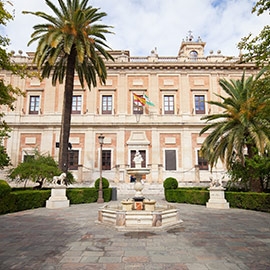
Reasons to study Spanish in Seville
THE CITY:
- Population: over 835,000
- Location: Southwest Spain
- Capital of the Autonomous Region of Andalusia
- Seville is a modern city with an extremely rich history dating back over 2,500 years
- The city has an international airport
- Seville has a Mediterranean climate with mild winters and extremely hot summers
CULTURAL/RECREATIONAL:
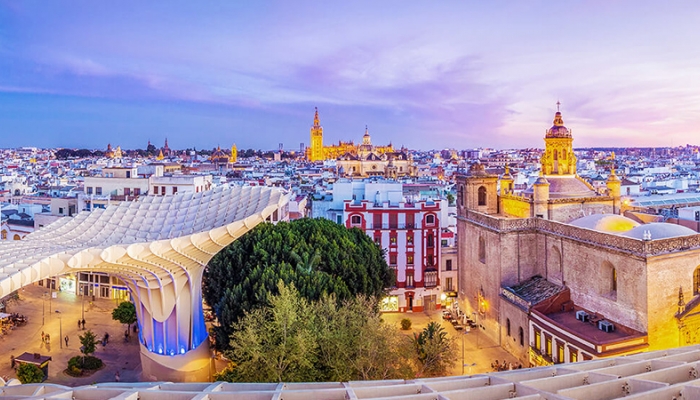
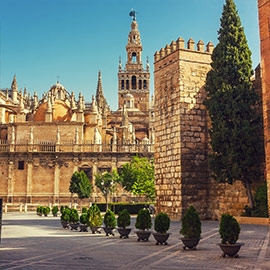
- Seville is a very complete city with a rich mixture of history and modernity that will add value to your Spanish course. Much of the history is reflected in the monuments of the city: the cathedral, the Giralda, the Alcázar, the Torre de Oro and the famous Barrio Santa Cruz quarter. If you would like to discover the popular customs of this region, you should visit Seville in the spring when the two most important festivities take place: Semana Santa (Easter Holy Week), with its world-famous processions, and Spain's most famous Flamenco event, the Feria de Abril.
- It is the world center for bullfighting and flamenco music.
- The "good life" is another of the traditions that the Sevillanos (Sevillians) like to maintain, as you will see from the many restaurants, bars and terraces that guarantee an entertaining and thrilling nightlife. In fact, Seville has one of the highest concentrations of bars in Spain!
- Seville has an international airport offering good communication from other Spanish cities and the rest of the world. Additionally, travel from Seville to Madrid only takes 2.5, thanks to high-speed trains known as AVE.
More information about Seville
Seville, the provincial capital, seat of the government and parliament of the Comunidad Autónoma de AndalucÃa (Regional Government), is located in the southwest Spain. With more than 700.000 inhabitants, the city is home to nearly half of the province's population!
The city of Seville is located on the Guadalquivir River, which crosses the city from north to south. The river can be navigated from Seville all the way to its outlet near Sanlúcar de Barrameda, on the Atlantic coast. In the past, the port of Seville played an important role in commerce between Spain and the Americas and today remains one of the most active river ports in the Iberian Peninsula.

La Torre del Oro
The Tartessians were the original founders of Hispalis. Next to this settlement, in 207 B.C., the Romans built Itálica which was the center of their Western Mediterranean dominion for seven centuries until the Empire was overrun by Northern barbarians towards the beginning of the 10th century. The long Moorish occupation of the Iberian Peninsula, from 711 A.D. to 1248 A.D., left indelible traces in Seville as in all of Al-Andalus (present day Andalusia). La Giralda, the tower of an important mosque, is the most well-known of the remaining Islamic monuments. Seville also played an important role in the 1492 discovery and conquest of America.
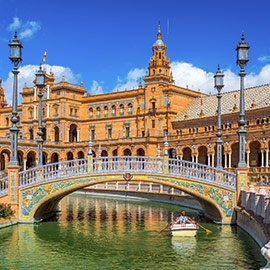
The 17th century was a period of artistic splendor in Seville. Painters such as Velázquez, Murillo and Valdés Leal, and sculptors like MartÃnez Montañés were born in Seville and all left behind important works. The city also took on a key role in world literature as the birthplace of the mythical Don Juan. Two events in the 20th century put Seville on the map, so to speak: the 1929 Latin American Exhibition that left important urban improvements in the city and the 1992 World Expo which reinforced the image of Seville as a modern and dynamic city.
Visitors should not miss out on the Seville's excellent tapas. The city is credited with their innovation and has more than a thousand bars where the choice of food is virtually unlimited, from seafood to ham and sausages, from vegetables to cheeses, the variety is endless. The Sevillians actually make a meal of them by moving from bar to bar, trying one dish at a time.

Barqueta's bridge
The cathedral and La Giralda
Fiestas and celebrations in Seville
During Semana Santa (Holy Week), celebrated towards the end of March/early April, there is movement of people throughout the region. The 'CofradÃas' (religious fraternities) and thousands of Sevillanos process in penitence through the streets of the city. During the whole week, sanctuaries are visited and people attend the many different religious masses. A public and multitudinous catechism perform in the streets around the sacred images of the brotherhoods, whose 'pasos' (floats) represent the distinct stages of the Passion, Death and Resurrection of Jesus Christ.
La Feria de Abril (April Fair) takes place in April and Sevillians begin preparations after Semana Santa ends. The famous fair features thousands of individual casetas (tents) are often set up as bars and decorated with lanterns, paper flowers, light bulbs, photographs, paintings, mirrors, lamps and more. Each caseta has its own style and competes to earn a prize.