Learn Spanish with don Quijote

In country Spanish Courses

Home > Culture > Spain > Places > Cities > The Alhambra of Granada

The Alhambra of Granada

The Alhambra of Granada

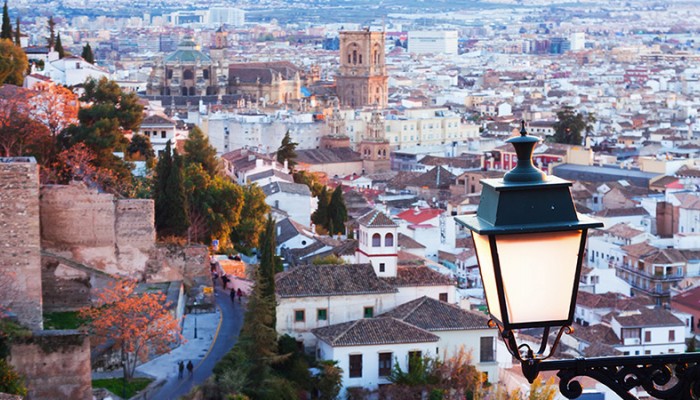
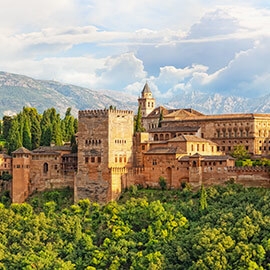
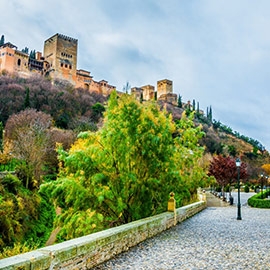
The complex palace of the Alhambra has been keeping watch over the city of Granada for centuries. It was the palace of the Nastrid dynasty, the last dynasty of the last Muslim King of Spain, between the years of 1238 and 1492.

Alhambra means “The Red” in Arabic (اَلْحَمْرَاء), and its complete name was "al Qal'at al-hamra" (Red fort). The origins of its name are unknown. Some Historians say it was named that because of the colour of the stones, others say the name is due to the fact that it was built at night, and the red colour gave it the appearance of fire emanating from torches. It could also be due to the person who ordered its construction, the founder of the Nastrid dynasty, Mohammed ben Nasar, named Al-Hamar el rojo (lit. The red The red) (because he had a red beard).

Inside the Alhambra there are richly decorated courts, mosques, defense towers, patios and gardens. It represents the peak of Islamic art in Spain and one of the most symbolic monuments of this type of art in the whole world.

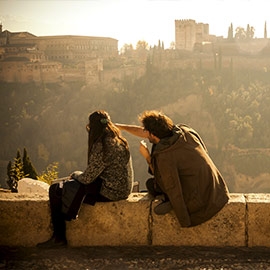
In 1492 the Catholic Monarchs conquered the city of Granada and the Alhambra came to be the Royal Palace and on its tower stood the flag and the Holy Cross. Boabdil, “El Chico” (The Boy) had to abandon what he called “El Paraíso Terrenal” (Earthly Paradise), heading towards the coast to go to Africa. On his way to the sea there is a mountain pass named “el Suspiro del Moro” (The North African sigh). From this place the whole of Granada can be seen and the Alhambra at the top of the hill. According to the tradition this pass was the place where Boabdil turned to look one last time at his beloved city, and he began to cry. His Mother reproached him saying: Llora como mujer lo que no has sabido defender como un hombre. (Crying like a woman is why you cannot defend (yourself) like a man).

Inside the Alhambra, its “Salón de Embajadores” (Hall of Ambassadors) was the place chosen by the King and Queen, Fernando and Isabel, to interview with Cristobal Colón and where the Monarchs agreed to support and finance his plan of travelling to China over the Atlantic Ocean.

In 1527 the emperor Carlos 5th ordered that a palace be built next to the Alhambra (specifically next to a certain part: El Palacio de Camares), a residential palace for his use only, even though he did not even have proof he could live there. The palace of Carlos 5th largely contrasts the art of Nastrid dynasty. Its style is of the Mannerism period and very advanced for its time. The square plan has a giant circular patio with two levels of columns, doric consisting the lower and ionic the higher and its décor shows influences from classical Roman art.

The Alhambra completes itself with “El Generalife”, a court of relaxation of the Nastrid Monarchy. It is and enclosure situated on the north side of the Alhambra. It is a court surrounded by gardens and orchards ideal for relaxation. The orchards and gardens can be found in big squares or terraces at different heights and are divided by thick retaining walls; some can still be seen today.

In “El Generalife” its fountains and ponds are particularly attractive, large works of hydraulic engineering that water the gardens.

In the words of Antonio Illecas, head of studies at don Quijote Granada:

“Como dice el refrán, “Quien no ha visto Granada no ha visto nada", y yo, que llevo viéndola durante 36 años, descubro pequeños detalles cada día. Todo aquel que quiera conocer el encanto de Granada debe venir aquí un tiempo."

“As the saying goes, “If you haven´t seen Granada you haven´t seen anything”, after seeing it for 36 years even I discover new things every day. Anyone who wishes to see the charm of Granada for themselves they should come at least once.”